Monday, June 16, 2014

Depression and Creativity Collide

Grant Wamack, rapper, writer, and existential warrior of the cosmos, has just dropped his new novella, A Lightbulb's Lament. Since the bizarro genre is a literary phenomenon that uses metaphorical devices to explore our emotions and our society, Grant discusses the role of depression in the creation of a hero so many of us want to be; a hero who is the figurative warrior against personal darkness--Mr. Watts. 


CLICK HERE TO BUY
Blog Postage (Lit Edition)
by Grant Wamack

Let's flashback to my freshmen year in college. I just moved out of the dorms and eased into a studio apartment in the heart of Northern Illinois University's campus. I was getting pretty good grades,  some of my short stories were beginning to be published, I had good friends who made sure I was making moves on the regular, I was finally able to get away from my dad's overbearing presence, but still... there was something nagging at me. Doubts about the future, terrible luck with women (even though I was surrounded by the “hook-up” culture), and most importantly I was still uncomfortable with myself. 

Cue existential crisis and questions. Why the fuck am I an English major?  I don't want to be a teacher. Why am I trying to please my Dad by majoring in English? I'm so much more than that. More than this. These thoughts would go on and on and I would sink into deeper levels of depression, dragging anyone in my immediate circle down with me. Everyone was partying on the weekends and I'd be in my room battling the black dog raging inside my head. 

Late nights spent alone watching Salad Fingers, consuming tons of weird fiction as a form of escapism, recording my first rap mixtape Heavenly Fridges, and lots of cathartic writing. It wasn't enough though. I had to do something to expel this energy. 

I carried a small notebook in my back pocket for ideas (I still do), and one day while working at Home Depot, I was struck with the image of a gentleman with a lightbulb for head and a world full of darkness. It was so compelling that I fleshed out a loose outline over the course of the next week. Earlier that year, I finished my first bizarro novella, Notes from the Guts of a Hippo, which was a major feat for me since I could barely write a 5,000 word short story. However, I had an idea and it had to be written. Not just to prove to myself that I could do it again, but to fix this depression holding me back.

It might be important to note that I've always been interested in magic, rather it be on stage, hoodoo, mysticism, astrology, or numerology. I thought of this as a ritual of sorts. I thought if Mr. Watts, the main character, could bring light to this fictional world that it could possibly bring that figurative light to my world as well. There's this idea if you work on your inner world, it will directly ripple out into the physical plane. 

Did it work? 

In a lot of ways yes; I'm in much better shape mentally thanks to affirmations, better eating habits, good friends, and self love. Mr. Watts represents a turning point in my life; his journey is my journey. All of us have moments of self-doubt and identity confusion, but I know there is a light in the darkness...

You can also check out his lyrical experimentation/exhibition...


Grant Wamack writes weird fiction, raps, and weaves dreams at night. During the day, the Navy employs him as a Mass Communication Specialist, in other words, a "super" journalist

Art: http://artspazm.tumblr.com/

Saturday, May 3, 2014

Zombie Horror: Reflections on a Genre

I still envision zombie fiction as a horror sub-genre, but it has evolved into its own genre. I don’t think that’s a bad thing; less than a decade ago, it was a challenge to find any zombie fiction at all. People like myself who grew up with zombie movies were teased by the possibilities; Romero and the other zombie-film directors were never given huge budgets to work with, so it seemed as if they spent more of their budget on the things that mattered most: makeup, gore, and securing a vivid location. I know Romero’s original Day of the Dead script was hacked to pieces, but I still love the film. 

Brian Keene, Joe McKinney, David Moody, Jonathan Maberry, Mark Tufo; these authors helped pioneer the emergence of zombie fiction as its own genre, almost separate from horror. Robert Kirkman’s Walking Dead comic series bridged the gap between niche-horror and mainstream entertainment. There are so many possibilities now for people who have an imagination; there are now thematic variations of zombie fiction. Survivalist, Dystopian, military adventure; these seem to be the popular incarnations. 

A lot of zombie fiction seems to be fit more into an action/adventure mold than horror; the survivalist books can still be frightening, because we have the anxiety that comes with surviving a natural disaster, the psychological damage, the fear of other survivors in a post-apocalyptic setting, etc. Then we have the Call of Duty video game zombie novels, in which we have a bunch of soldiers at war with zombies. We still have books where swords can magically decapitate zombies (if you know me, you know this is a HUGE pet-peeve of mine), and that’s cool. That’s what people want to read. I think there is a lot of potential in this particular fiction market, but…

What happened to zombie horror?

Zombies just aren’t very scary in most books. 

I’m not attempting to deviate into what is scary about the books, but rather, I would like to find out where the zombie fiction books that portrayed the undead as terrifying WITHOUT the emphasis on post-apocalyptic-survivalist-military action. Yes; the living are often more terrible than the zombies. WE GET THAT. There is so much potential in the zombie idea, but we are seemingly stuck. There are some original stories out there, but they’re harder and harder to find. I’m bored with zombie fiction. Very, very bored. I don’t like most of it. In fact, I dislike the vast majority of it. About 99.9%. 

So I decided to write the zombie books that I would want to read. I could still incorporate plenty of action, but I wanted the zombies to become menacing again. I wanted to read beautiful prose, so I made an attempt. My zombie books have a lot of detail; according to reviewers and blog reviews. A lot of my characters aren’t good people (I wrote a blog post once about my belief that “good” people wouldn’t survive  very long in a zombie-apocalypse scenario), but they are still not as bad as the zombies… so there is still a contrast. The zombies are always more terrifying. 

The Zombie Acension trilogy is nearing its end. The final book in the trilogy involves a heavy look at PTSD and survivor’s guilt as it would relate to a post-apocalyptic scenario. The book, titled Saint Pain, is about the never-ending horror that has become a sort of disease; the horror of survival. Robert Kirkman briefly writes about the subject in the Walking Dead comic, but I wanted to take it a step further.

A zombie apocalypse should be brutal, terrifying, awful. We’re talking about a world that has become lawless…

I suppose I wrote this blog because now I'm being labeled as a poet, bizarro writer, editor... and I used to avoid being called a "zombie author." 

My work is zombie horror. Maybe a bit of survival horror (I hear that’s a sub-genre, too), with some explosions and bullets and sex sprinkled in. I take that back. A lot of bullets, a lot of sex, and a lot of blood. 
My civil war book, Nightmare of the Dead, is almost entirely a horror novel that features zombie-like creatures as monsters, but in the end, it’s horror. 

The horror, the horror…

I want zombie horror, so I wrote it. My vision of the apocalypse is a dark one… there is no cure for death, there isn’t a knight in shining armor coming to save the human race…

Monday, March 24, 2014

Dark Souls 2: My Obsession and Addiction


I grew up playing video games; the NES era had a lot of games that would be difficult by today’s standards. Most games on the market today are easy and focus heavily on the multiplayer element, which I can understand, but I’m not a big fan. I’m used to playing with someone sitting beside me, or braving the mighty robots of the Mega Man universe by myself.

I used to love playing the Final Fantasy games, but the last three entries have been awful, in my opinion (I’m talking about the trilogy of crap called Final Fantasy XIII). I used to love playing video games, but most games are too easy, or they’re a Call of Duty clone. Don’t get me wrong—I’ve played several games that I absolutely love, but most of the franchises I used to love (Resident Evil), suck. I have to play Suda 51 games, games most people hate, just to get something “different” out of a video game. To me, most games are the same. Open-world games usually bore me to death, unless it’s one of the Fallout games.

I remember stumbling upon an article on IGN about the ten hardest games in the last few years, and I saw Dark Souls on the list. I had no idea what it was. I bought the game for Xbox, and I obsessed over it. Absolutely obsessed over it. I felt like a teenager all over again because I spent countless hours playing it. My wife screamed at me several times. 

"IT'S A STUPID VIDEO GAME!"

"I'LL BE DONE IN A MINUTE!"

(Two hours and several deaths later...)

The game was difficult at first, sure, but once you became accustomed to the combat system, it's fairly easy. When I re-started with a different character, I wiped the floor with Smough and Ornstein, one of the hardest boss battles in the game. I beat them in one try. The game was hard, but it wasn’t impossible.

So. Dark Souls II.

I haven’t wanted to play a game this badly since Final Fantasy VIII; the release date was circled on my calendar. I’m 31 years old with two kids and a good job, but here I was, fantasizing about a forthcoming video game. I actually went out and bought at PS3 just to play Demon’s Souls, which I also loved. Dark Souls is the only game I’ve played more than once since the Resident Evil 2 days. 

There’s been a lot of hullabaloo over which Dark Souls game is better, and some people are bothered by the graphics. I feel like we’re comparing Megan Man 2 to Megan Man 3; both games are fun and challenging. I’ve read articles from several reviewers who say that Dark Souls II fails to live up to expectations because they liked the Firelink Shrine idea from the first game because the world felt “connected” to a middle place. Well, you can walk back to your “home” in Majula in Dark Souls II, but it would be a very long walk from some places. That’s not always the case, but the game certainly has a central hub. The graphics aren't perfect, but I like how the world looks "tired" and wasted. 

Human effigies are tough to come by. You can keep repairing a ring that will break every time you die, but it costs 3000 souls to fix and you have to keep warping back to the blacksmith to get it fixed—the inconvenience is enough to keep me from being reckless. 

The game world feels far more “coherent” than the last game did, despite the fact that some professional game reviewers prefer the Firelink Shrine idea. There is a bit more story, and it’s an intriguing one. The game is still mysterious.

There is certainly an emphasis on multiplayer, but I’m okay with it because I don’t have to voice chat with juveniles to enjoy it. I prefer to use a warrior so I can play with all the cool weapons, but I’ve noticed that some bosses are easier to take down with a character who can keep their distance and throw magic spells. It seems like some bosses would discourage this strategy. 

The game is a cross between Demon’s Souls and Dark Souls. I am displeased with the game’s AI, because you can easily bait some enemies to a certain point, and for whatever reason, they began to backtrack, allowing you to shoot them with your bow or hit them with something else from a distance. Enemies normally just stand there and take it when you’re pelting them with arrows from a distance. I can only imagine how hard some parts of this game would be if enemies ducked behind cover or tried to flank you. 

I usually get wasted when I’m summoned to another world by another player, but I like hanging out in the belfry, because I usually win those fights. There are different ways to approach multiplayer this time around. I’ve noticed how important the poise stat has become, and opponents with small, quick weapons can stagger you and hit you with a devastating combo as soon as they can find an opening.

I could go on and on. I love Dark Souls II. I love Dark Souls. I love Demon’s Souls. Like the old NES games, I’ll keep playing them and playing them, because the challenge is always fresh and fun. I’m embarrassed by the number of hours I’ve logged on the game since it came out. I always criticize people who sit there and play Flappy Birds and Candy Crush when they could be reading a book, and here I am… I could be WRITING a book…

Saturday, March 22, 2014

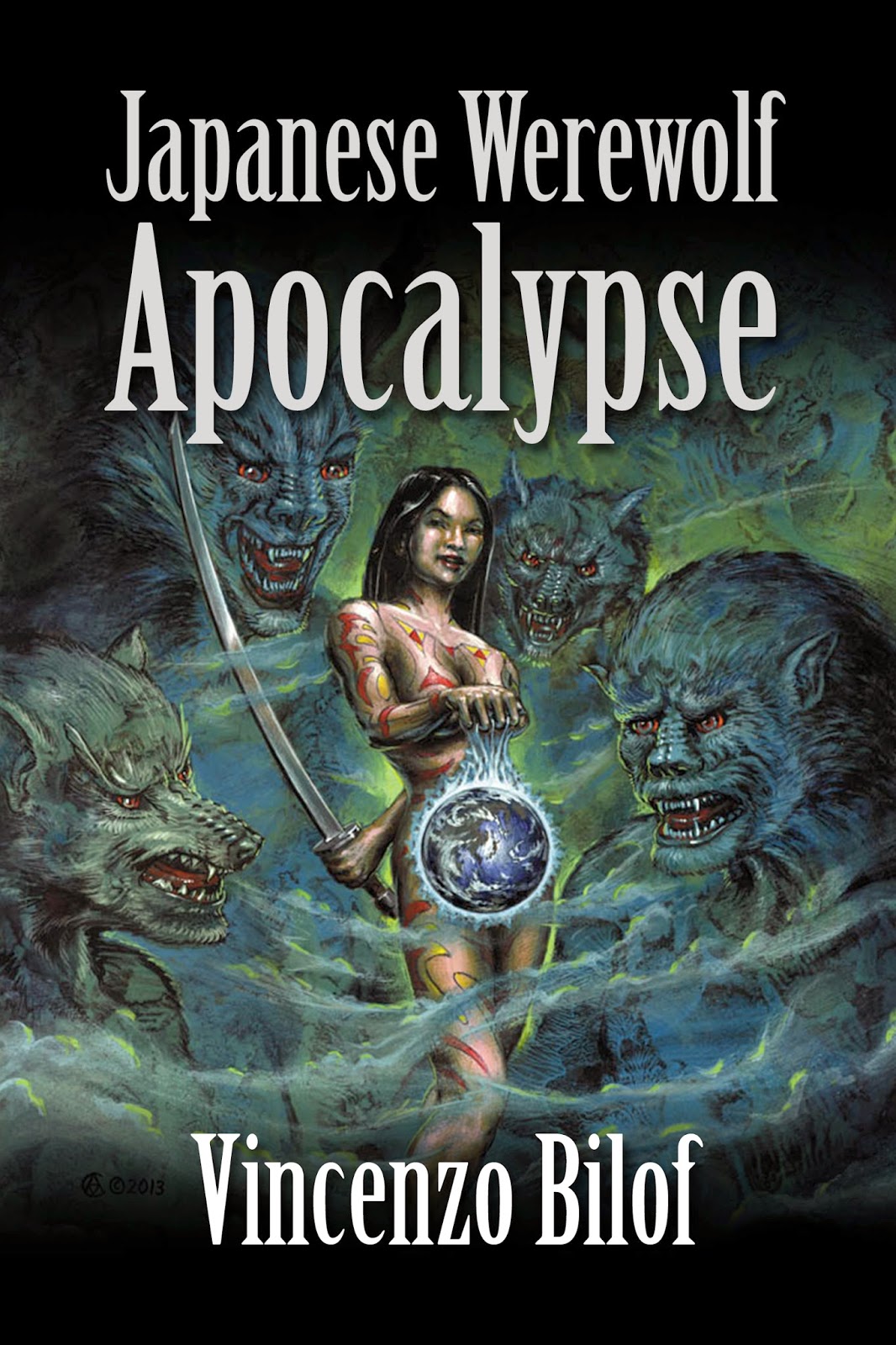
Writing the Werewolf Apocalypse

The book is finally available from Severed Press, with an awesome cover by Alan M. Clark. In the foreword, I explained why I wrote the book; the novel is essentially a love letter to Takashi Miike and Meiko Kaiji, both legends in Japanese cinema.

CLICK HERE TO BUY THIS THING 

For me to say the book is violent and original is a bit pretentious. I will say I used a different approach when writing the book, and did whatever I could to capture a sort of Japanese aesthetic to the prose. The book is a big one (over three hundred pages), but there aren’t many large paragraphs. Sometimes, there is beauty in “simplicity”; so I didn’t write the thing like it was a Haiku, but I wanted readers to infer and “feel”; telling readers much of anything would have ruined the cultural context. 

Are there werewolves in the book? Yes. A lot of them. 

Meiko Kaji in Lady Snowblood
I didn’t create a “dream cast” for this book on the blog because a lot of the actors would be Japanese, and not many folks know about the actors who I’d want in the movie. I’m also biased; I think even the “cheesy” Japanese films, or even the horror films, take their approach to acting and presentation far more seriously than most American film studios. An American film studio couldn’t make this into a movie. No way. Not even Tom Cruise. 

I won’t apologize for how “weird” the book might seem. I won’t apologize for anything in this book. It shifts between stories, jumps around, and entire chapters are presented differently. It’s exploitative, ridiculous, and very, very, Japanese. 

With werewolves, of course. Many of them. Many, many werewolves

Takashi Miike's remake of Hara-Kiri. A movie that is kind of "normal" for him, although depressing as hell.


Sunday, March 9, 2014

THE BEST INDY PUBLISHER


A lot of publishers do their best to advertise their books as original works of art. At least, I think a lot of presses follow this model. I think a lot of readers enjoy reading books that are similar to others they’ve read in the past, especially when it comes to genre; a reader who enjoys The Hunger Games might be looking for more Dystopian fiction, for example.

Although I write stories of my own, I love to read. I’m under the impression that a lot of writers also read, though I can’t say ALL writers read because I don’t know that to be true. Writers have different goals in mind when it comes to publication, but there is a select group of writers out there who enjoy writing what hasn’t been written before. I’m talking about writers who write for a select audience, an audience they also belong to.

I know it’s true that writers often write in genres they love, but what if there are writers who enjoy writing for the sake of writing, for the sake of art itself? Do these writers exist? What do we consider ART? It’s subjective, of course, but I believe I have found a publisher that specializes in art. A publisher that exists for the writers it publishes, who also happen to be the publisher’s audience.

Dynatox Ministries, I love you.

To have your work published by them you need to purchase their books; Limited-edition chapbooks written by authors who want to read what Dynatox publishes. There are authors from all over the world, including Sebastien Doubinsky, Chris Kelso, Michael Faun, and several others.

What exactly do they publish? What’s the big deal?

Their books include the work of authors who do not care about narrative, literary, or grammatical rules. Dynatox Ministries has several imprints, including a bizarro imprint (Holy Mountain Outreach), and a hardcore horror/noir crime imprint (Christbait Rehab). They publish conspiracy theory books, poetry, nunsploitation, blaxsploitation, Nazisploitation, and they’re publishing a box set dedicated to the cannibal-horror genre. Authors are paying tribute to underground subgenres of film and art that have existed for several years—Dynatox Ministries is the only place you can find these books.


Did I mention the books are limited-edition? You can pre-order the books, and they do take a little while to come out, but the wait is worth it. These books will be out of print. Dynatox is also one of the few publishers dedicated to producing actual books; while they do have an “electronic division,” their books each come numbered.

You’re missing out if you’re not reading their books, or maybe you just like to read the same thing over and

over again? That’s not a bad thing. If you want something that’s actually different, and work that is meant to be appreciated for what it is rather than how much it entertains, Dynatox has what you’re looking for. In my opinion, the best part is there is no pressure to review books once you’ve purchased them. The books are limited edition, so who cares?  I’ve left a few reviews on Goodreads for some of the books, but I prefer to just leave stars. Gold stars. Lots of gold stars.


Check out what Dynatox has to offer. They’re currently about to host a convention called Krallcon, so some of the books were published for people who donated (and you can donate to the convention by ordering the new books, hence why they are a bit more expensive).

The books are sexy. The authors are sexy, too. Especially Jason Wayne Allen and R.A. Harris. Rumor has it that Chris Kelso is sexy, too, but he lives in a fictional land that served as the backdrop for Highlander and Braveheart, so we know his home isn’t real…


Here's where you can buy their stuff. CLICK HERE